
VMware Cloud Foundation 9.0 was officially launched and made generally available on June 17, 2025 — a major step forward driven by Broadcom’s unified vision.
For years, organizations faced a tough decision in digital transformation: embrace the speed of the public cloud or maintain control with on-premises infrastructure—often sacrificing agility and accumulating complexity and technical debt. Today, that trade-off no longer holds up.
Modern workloads—particularly those involving AI and massive datasets—demand a new approach. Petabyte-scale data can’t simply be moved across regions. Regulatory pressures are requiring sensitive workloads to stay within national borders.
VMware Cloud Foundation (VCF) 9.0 reimagines the private cloud, delivering cloud-like speed and agility while ensuring the performance, governance, and cost-efficiency enterprises expect on-prem.
VMware Cloud Foundation (VCF) 9.0 well-executed Private Cloud:
- Treats compute, storage, and networking as dynamic, software-defined resources
- Offers developers on-demand access via APIs, bypassing traditional ticketing systems
- Runs VMs, containers, and AI workloads natively and equally
- Maintains operational consistency from data center to edge to sovereign cloud
- Embeds security and compliance by design, with policies that follow workloads wherever they go. It marks a significant milestone in VMware’s private cloud evolution—built on over two decades of virtualization leadership.
The Strategic Shift in VCF 9.0:
Each major release of Cloud Foundation has advanced automation, but VCF 9.0 makes private cloud operations and consumption the centerpiece. It’s not just about running infrastructure—it’s about managing it cohesively.
This release brings unified context to the forefront. Whether provisioning resources, onboarding users, or responding to capacity issues, the same policy framework, APIs, and lifecycle management tools apply. This streamlined experience lowers the barrier for operators, accelerates developer productivity, and reduces operational risk by minimizing tool fragmentation and configuration drift.
VMware Cloud Foundation 9.0
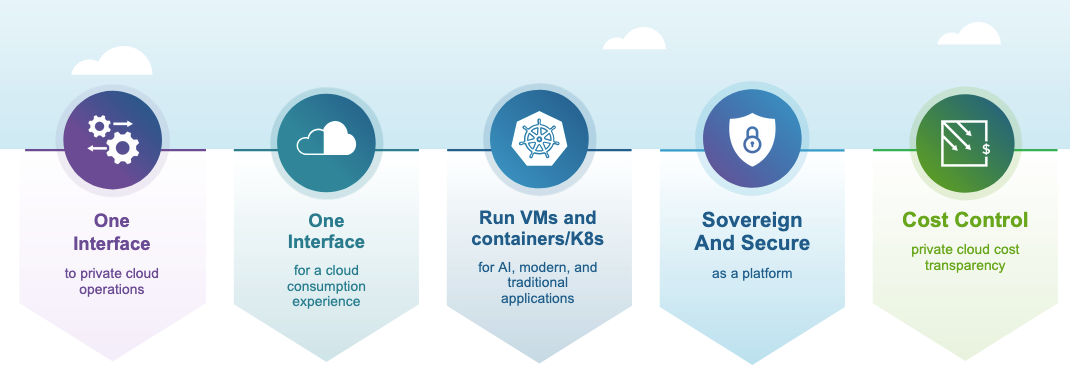
A Unified Command Center for Private Cloud Management
Gain a comprehensive view of health, patching, and compliance across your entire private cloud from a single dashboard—enabling consistent, data-driven operational decisions with no silos.
One Endpoint for Developers, Many Ways to Build
Offer developers a streamlined experience with a single integration point for Infrastructure as Code—whether using Terraform, REST APIs, or VCF-native automation blueprints—eliminating the need for multiple plugins or workarounds.
VMs and Kubernetes, Running in Harmony
Deliver high-performance virtual machines and production-grade Kubernetes side by side on the same platform. Built-in CI/CD with Argo CD integration enables seamless deployment from repository to runtime without external tooling.
Platform-Level Sovereignty and Security
Built-in support for data residency, geo-fencing, and automatic certificate rotation ensures each cluster aligns with regulatory and sovereignty requirements. It’s not just on-prem—it’s intelligent control over where data lives and how it’s protected.
Cost Intelligence that Drives Action
Real-time visibility into resource usage through chargeback, showback, and predictive cost analytics empowers teams to budget, allocate, and expand infrastructure based on actual consumption trends tied directly to deployment data.
VCF 9.0 isn’t just an upgrade—it’s a new blueprint for the private cloud. With enterprise-grade improvements across automation, observability, and compliance, it redefines how modern infrastructure should be deployed and operated. This release brings simplicity to complexity, enabling faster innovation, tighter governance, and operational excellence at scale.
Discover What’s New in VMware Cloud Foundation 9.0: Innovations That Drive Results
VMware Cloud Foundation 9.0 introduces key platform enhancements built to speed up time-to-value, simplify operations, and support scalable growth.
With breakthroughs across automation, security, and performance—including the reimagined Operations Console—VCF 9.0 addresses today’s complex infrastructure demands while preparing organizations for future needs.
We’ve already covered the overarching changes that define VCF 9.0 These falls into two major categories:
Core Platform Enhancements: Continued innovation in areas like performance tuning, storage efficiency, and data protection that reinforce the VCF foundation.
Outcome-Oriented Features: Practical tools designed for real-world use cases, grouped under the themes of Modern Infrastructure, Unified Cloud Experience, and Secure & Resilient Operations.
While the complete list of enhancements is extensive, here are some standout features that highlight the value of VCF 9.0:
→ Smart NVMe Memory Tiering:
Traditional DRAM limitations are a barrier for high-performance applications like in-memory databases, trading systems, and large-scale analytics. This creates a dual-tier memory pool, keeping active workloads close to the CPU and offloading cold memory pages to fast flash—delivering higher density and performance without extra hardware spend.
→ Cross-Cluster vSAN Deduplication:
Flash storage continues to drive private cloud expenses. The new global deduplication capability in vSAN now operates across clusters, not just local disks. This innovation eliminates redundancy across your environment, allowing you to store more data on less hardware—without the usual performance overhead.
→ Optimized Data Paths with DPU Acceleration:
AI, microservices, and other east-west heavy applications are often slowed by intra-cluster latency. VCF 9.0 introduces kernel-level optimizations and DPU offloading to streamline network traffic. By minimizing switch hops and keeping data local longer, it significantly improves inference times, API response rates, and overall workload efficiency—possibly postponing costly infrastructure upgrades.
But VCF 9.0 isn’t just about powerful features—it’s about achieving operational excellence. This release helps reduce infrastructure costs, improve resource utilization, and unlock new performance levels across diverse workloads.
Conclusion:
VMware Cloud Foundation 9.0 represents a bold leap forward in private cloud innovation, combining cloud agility with on-premises control. Its unified platform simplifies operations, boosts performance, and ensures enterprise-grade security and compliance.
From enhanced automation to intelligent resource management, VCF 9.0 empowers IT teams to scale with confidence. It’s not just an upgrade—it’s the future-ready foundation for modern, resilient, and efficient infrastructure.